
The recent early view publication of the ERS Task Force statement on advanced telemonitoring in sleep apnoea is a welcome addition to the evidence base for clinicians and patients providing up to date guidance on best practice in this speciality. The statement led by Dr Johan Verbraecken and an international team of experts explores the expanding role of telemedicine in managing obstructive sleep apnoea across its clinical pathways from diagnosis to long-term follow-up 1.
So let’s explore how these statements may apply to Sleep Medicine services and clinicians in the UK:
- Remote attended video-based Polygraphy/Polysomnography is feasible and significantly reduces the failure rate compared to unattended sleep studies. Although remote attended video-based polygraphy (PG) and polysomnography (PSG) are technically feasible in the UK, their availability is limited. Most NHS sleep diagnostic services depend on in-lab studies or unattended home sleep tests due to resource and infrastructure constraints. In contrast, private providers may offer advanced options such as telemonitoring and remote-attended sleep studies.
- Tele transmission of Polygraphy/Polysomnography raw data is practical, shortens the time to OSA diagnosis, and lowers costs. Tele transmission is available in the UK, but primarily through private sleep clinics, not as a routine NHS service. The NICE approved novel home sleep apnoea testing devices, Sunrise, WatchPAT and Acupebble are able to tele transmit sleep study data via cloud based platforms.
- Teleconsultations for reviewing home-based sleep study results are effective, cost-saving, and deliver high patient satisfaction. Many services have now adopted teleconsultations for remote reviews where is is safe to do so and its patient preference.
- Unsupervised APAP titration at home, combined with telemonitoring for pressure adjustments, achieves comparable CPAP settings and compliance over 1–12 months. Recently published data from Italy has shown that longer term telemonitoring does improve therapy adherence with an 80.66% reported adherence over a 6-year follow-up period 2.
- Telemonitoring-based diagnosis and management of OSA outside hospital settings reduces costs by eliminating inpatient stays, cutting travel expenses, and improving productivity. If the NHS are to tackle the long waits for diagnostic testing and commencing therapy where required then adoption of these telemonitoring pathways need to proceed at pace in line with the Optimal Sleep Pathway recommendations by the BSS 2025 3,4,5.
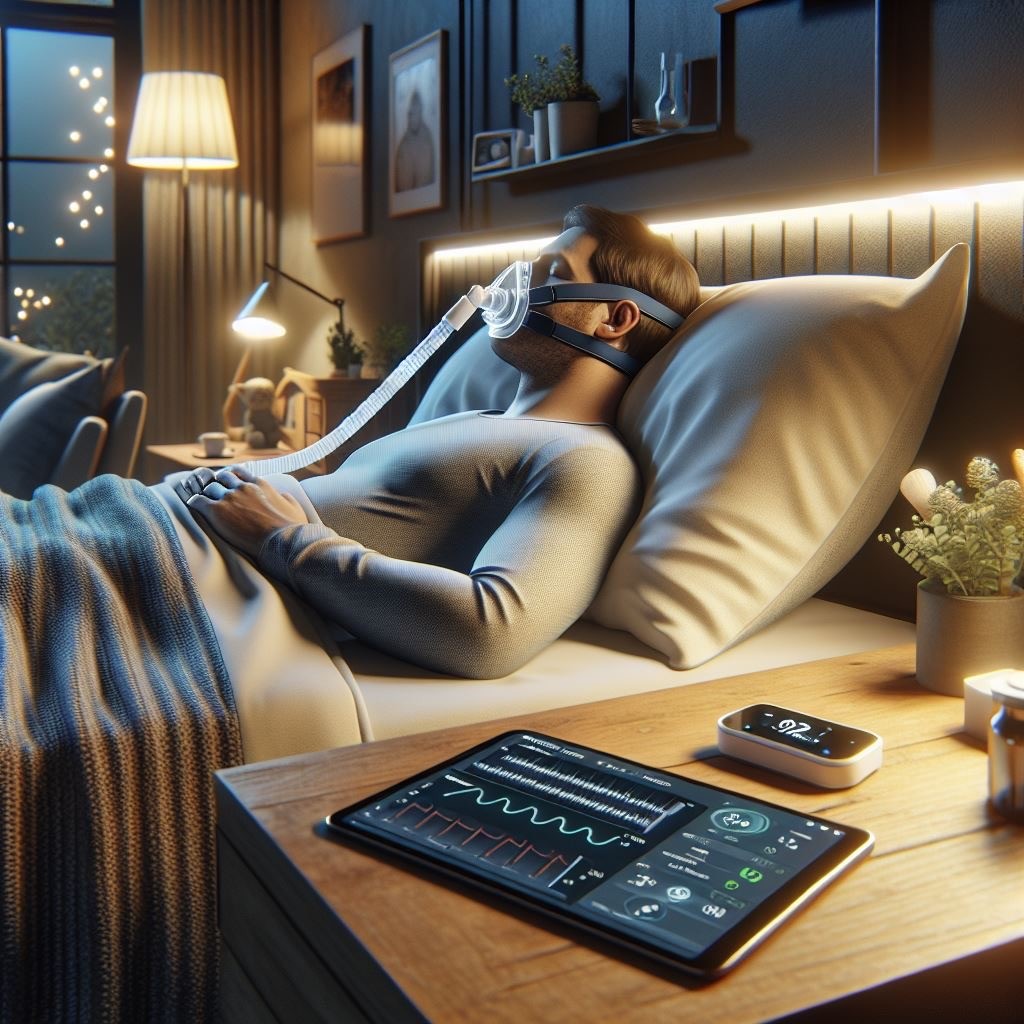
NHS 10-Year Plan & Telemonitoring: Why It Matters
The NHS Long Term Plan places significant emphasis on digital transformation and proactive care and telemonitoring fits perfectly into this vision 5.
✅ Supports Early Intervention
Continuous remote monitoring helps detect issues like sleep apnoea, hypertension, or COPD before they escalate, thus reducing hospital admissions.
✅ Empowers Patients
Patients can track their health from home, improving engagement and adherence to treatment plans.
✅ Optimises Workforce Efficiency
Clinicians can prioritise high-risk cases using real-time data, freeing up resources for critical care.
✅ Improves Outcomes for Chronic Conditions
Conditions such as Sleep Apnoea and heart failure and respiratory disorders benefit from ongoing monitoring, aligning with NHS goals for integrated care.
✅ Cost Savings
Telemonitoring reduces unnecessary appointments and admissions, supporting sustainability targets in the NHS plan.
So what does this mean in terms of CPAP/APAP device manufactures and their specific device algorithms?
Should CPAP Device Algorithms Be Standardised?
CPAP and APAP devices use proprietary algorithms to detect events and adjust pressure, but these algorithms vary widely between manufacturers.
Why does this matter?
- Different detection thresholds and response speeds can lead to different therapy experiences for patients.
- Research comparisons become challenging when devices don’t speak the same “language.”
Arguments for standardisation:
✅ Consistent care across devices
✅ Easier interpretation of clinical studies
✅ Improved patient safety
Arguments against:
❌ May stifle innovation and competition
❌ Reduces flexibility for patient-specific needs
❌ Complex global regulation
Current approach:
Guidelines (e.g., AASM) recommend performance standards, not identical algorithms. Transparency and interoperability may be the middle ground.
👉 What do you think ? Should we aim for full standardisation or maintain flexibility for innovation?
SleepMedicine #CPAP #OSA #DigitalHealth #SleepTherapy
References:
- European Respiratory Society statement on advanced telemedicine for obstructive sleep apnoea (e-Sleep)
- View of Determinants and rate of long-term adherence to continuous positive airway pressure in obstructive sleep apnea: a multicentre retrospective study
- Multiple-access versus telemedicine home-based sleep apnea testing for obstructive sleep apnea (OSA) diagnosis: a cost-minimization study – PMC
- Economic evaluation of telemonitoring as a follow‐up approach for patients with obstructive sleep apnea syndrome starting treatment with continuous positive airway pressure – Ssegonja – 2024 – Journal of Sleep Research – Wiley Online Library
- NHS England » Fit for the Future: 10 Year Health Plan for England