
Definition and references of three oxygenation metrics used in sleep-disordered breathing research: Hypoxic Burden (HB), Sleep Apnoea-Specific Hypoxic Burden (SASHB), and Hypoxic Load (HL) and clarifies how they relate to one another in the primary literature.
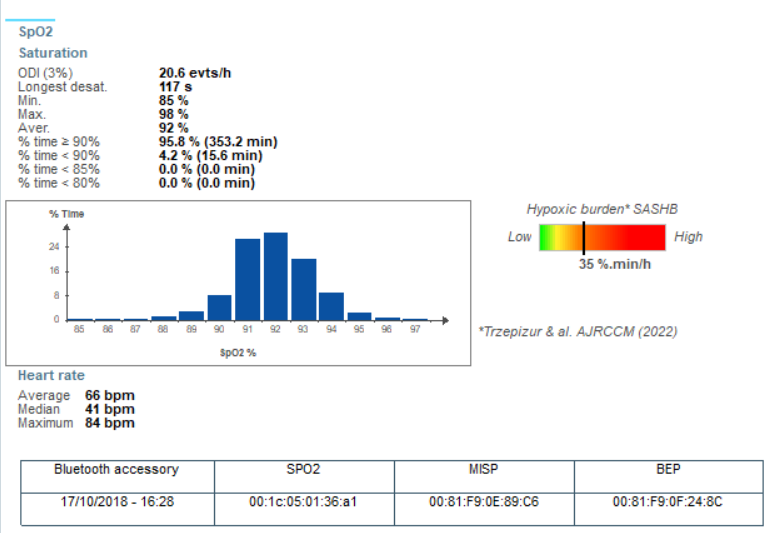
Image taken from Sefam Analyse software example.
1. Background
The apnoea-hypopnoea index (AHI) counts respiratory events but disregards the depth and duration of the associated oxygen desaturations. This has driven the development of area-based oxygenation metrics intended to better capture the physiological severity of sleep-disordered breathing and its association with cardiovascular and cognitive outcomes. Three closely related terms recur in this literature and are frequently used inconsistently: hypoxic burden, sleep apnoea-specific hypoxic burden, and hypoxic load.
2. Hypoxic Burden (HB)
Definition: The total area under the respiratory event-related desaturation curve.
First described by Azarbarzin et al. (2019) [1]. HB is calculated by identifying each respiratory event-related desaturation, measuring the area between the desaturation curve and a pre-event baseline within a defined search window, summing these individual areas, and normalising by total sleep time.
- Units: %min/h
- Captures: frequency, depth, and duration of desaturation in a single value
- Key outcome data: associated with cardiovascular disease-related mortality in the Sleep Heart Health Study and the Osteoporotic Fractures in Men (MrOS) Study [1]
3. Sleep Apnoea-Specific Hypoxic Burden (SASHB)
Definition: The sum of individual areas under the oxygen desaturation curve, as used in Azarbarzin et al. (2020) [2] to denote HB applied specifically to OSA-related desaturations.
The calculation is identical to HB above. The literature does not operationalise SASHB as a distinct metric from HB however later papers from the same group, and subsequent citing literature, use “HB” and “SASHB” interchangeably for the same area-under-the-curve calculation [2][3]. The change is one of labelling and context (emphasising OSA-specificity), not of method.
- Units: %min/h (same as HB)
- Key outcome data: predicted incident heart failure in the Sleep Heart Health Study and MrOS cohorts [2]; associated with coronary artery disease severity [3]
4. Hypoxic Load (HL)
Definition: Not a single metric, but a family of area- and duration-based desaturation parameters developed independently by Finnish signal-processing research groups (Kulkas, Karhu, Tiihonen, Leppänen, and colleagues).
HL is typically reported as several linked parameters, including desaturation severity (DesSev — area under the desaturation curve, normalised by total analysed time), desaturation duration (DesDur), and corresponding recovery-event indices (RecSev, RecDur), alongside the oxygen desaturation index (ODI) [4][5]. Some more recent usages simplify “hypoxic load” to mean the area under the curve of desaturations meeting a given threshold (e.g. ≥3%) linked to AHI-scored events conceptually adjacent to HB/SASHB but derived from a distinct scoring and analysis pipeline and not treated as formally equivalent in the literature (6).
- Units: vary by parameter (%-point, seconds, events/h)
- Key finding: scoring criteria (e.g. minimum desaturation threshold) materially affect HL parameter values, which has implications for cross-study comparability [4]
5. Comparison at a Glance
| Metric | Originating group | Calculation basis | Units | Status |
| Hypoxic Burden (HB) | Azarbarzin et al., Harvard / Brigham | Total area under the respiratory event-related desaturation curve, summed and normalised by total sleep time | %min/h | Original term (2019) |
| Sleep Apnoea-Specific Hypoxic Burden (SASHB) | Azarbarzin et al., Harvard / Brigham | Identical area-under-curve calculation to HB, applied to OSA-related desaturations | %min/h | Same construct, later relabelling (2020) |
| Hypoxic Load (HL) | Kulkas, Karhu, Tiihonen, Leppänen, et al. (Finnish signal-processing groups) | Family of area- and duration-based desaturation parameters (DesSev, DesDur, RecSev, RecDur) plus ODI, from a separate scoring pipeline | Varies by parameter (%-point, s, events/h) | Separate lineage; equivalence to HB disputed by originating groups (see Section 6) |
6. Key Message
HB and SASHB are not operationally distinct constructs in the primary literature. Both refer to the same area-under-the-desaturation-curve calculation, normalised by sleep time and expressed in %min/h; SASHB is best understood as the later, OSA-specific label applied by the originating group to the same metric, not a methodological refinement of it. A three-way framework that treats HB, SASHB, and HL as parallel, equally distinct metrics oversimplifies the picture: the primary distinction is between the Azarbarzin HB/SASHB approach and the separate HL family from the Finnish groups, not between HB and SASHB themselves.
However, even the HB/SASHB-versus-HL boundary is not fully settled. Leppänen et al. argued in a 2019 commentary that HB is methodologically equivalent to the pre-existing Finnish “desaturation severity” (DesSev) parameter, part of the HL family, rather than a novel metric [7]. Azarbarzin et al. replied, distinguishing their work primarily on the basis of being the first large community-based cohort validation rather than a fundamentally different calculation [8]. Readers should therefore treat the HB/SASHB-HL distinction as a live point of disagreement between the originating groups, not a settled methodological boundary.
A recent innovation by Sefam is the addition of HB/SASHB into the Sefam Analyse software which can be measured using the Nonin 3150 wrist oximeter via blue tooth connectivity with the Sefam CPAP/NIV devices and downloaded via the device data card. With this functionality as a clinician leading a sleep medicine service is this information important to see when managing more complex patients with underlying multi-morbidity?
References
1. Azarbarzin A, Sands SA, Stone KL, Taranto-Montemurro L, Messineo L, Terrill PI, et al. The hypoxic burden of sleep apnoea predicts cardiovascular disease-related mortality: the Osteoporotic Fractures in Men Study and the Sleep Heart Health Study. Eur Heart J. 2019;40(14):1149–57.
2. Azarbarzin A, Sands SA, Taranto-Montemurro L, Vena D, Sofer T, Kim SW, et al. The Sleep Apnea-Specific Hypoxic Burden Predicts Incident Heart Failure. Chest. 2020;158(2):739–50.
3. Martinez-Garcia MA, Sánchez-de-la-Torre M, White DP, Azarbarzin A. Hypoxic Burden in Obstructive Sleep Apnea: Present and Future. Arch Bronconeumol. 2023;59(1):36–43.
4. Muraja-Murro A, Kulkas A, Hiltunen M, Kupari S, Hukkanen T, Tiihonen P, et al. Adjustment of apnea-hypopnea index with severity of obstruction events enhances detection of sleep apnea patients with the highest risk of severe health consequences. Sleep Breath. 2014;18:641–7.
5. Kulkas A, Duce B, Leppänen T, Hukins C, Töyräs J. Severity of desaturation events differs between hypopnea and obstructive apnea events and is modulated by their duration in obstructive sleep apnea. Sleep Breath. 2017;21(4):829–35.
6. Gagnadoux F, Le Vaillant M, Paris A, et al. Relationship Between Hypoxic Load and Cardiovascular Morbidity in Obstructive Sleep Apnea. American Journal of Respiratory and Critical Care Medicine. 2024;209(7):853-863.
doi: 10.1164/rccm.202306-1050OC
7. Leppänen T, Kulkas A, Töyräs J. The hypoxic burden: also known as the desaturation severity parameter. Eur Heart J. 2019;40(35):2991-2993.
doi: 10.1093/eurheartj/ehz271
8. Azarbarzin A, Sands SA, White DP, Redline S, Wellman A. The hypoxic burden: a novel sleep apnoea severity metric and a predictor of cardiovascular mortality-Reply to ‘The hypoxic burden also known as the desaturation severity parameter’. Eur Heart J. 2019;40(35):2994-2995.
doi: 10.1093/eurheartj/ehz273